
Learn about Air-Cooled Diesel Generator Cooling Systems
During long-term operation of a diesel generator set, a large amount of heat is continuously generated inside the engine. If this heat cannot be removed in a timely and effective manner, the diesel engine temperature will rise excessively, leading to power reduction, accelerated wear of components, and even serious failures. Therefore, the cooling system is one of the indispensable and critical systems in a diesel generator set. Among various cooling methods, the air-cooled cooling system has been widely applied in small-power diesel engines and some engineering generator equipment due to its simple structure, strong adaptability, and ease of maintenance.
This article provides a comprehensive, in-depth, and easy-to-understand analysis of air-cooled diesel generator cooling systems from multiple perspectives, including basic principles, system components, layout configurations, cooling intensity regulation, typical applications, maintenance and troubleshooting, advantages and disadvantages, and suitable application scenarios, helping readers systematically understand this cooling technology.
An air-cooled diesel generator cooling system uses air as the cooling medium and is therefore also referred to as an air cooling system. Its core principle is to use a fan to drive a large volume of air at high speed, allowing the air to come into direct contact with high-temperature components of the diesel engine, thereby carrying away heat and discharging it into the surrounding environment.
Unlike water-cooled systems, which rely on coolant for indirect heat transfer, air-cooled systems employ direct heat exchange. As air flows over the cylinder, cylinder head, and other high-temperature parts, it rapidly absorbs heat, its temperature rises, and it is then expelled from the system, achieving continuous cooling. This approach eliminates the need for a coolant circulation system, resulting in a simpler overall structure.
To improve heat dissipation efficiency, the outer surfaces of diesel engine cylinders and cylinder heads are typically machined with a large number of regularly arranged cooling fins, significantly increasing the contact area with air. At the same time, air shrouds and guide vanes are used to properly direct airflow paths, making cooling more concentrated, uniform, and efficient.
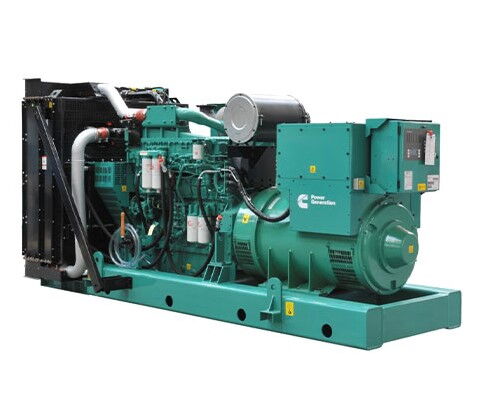
Although the air-cooled cooling system of a diesel generator is relatively simple in structure, each component plays an important role and works in coordination with others to complete the cooling task.
- Cooling Fins: Cooling fins are usually arranged on the outer walls of the cylinder and cylinder head and are among the most visible and critical components of the air-cooled system. By increasing the surface area, cooling fins significantly enhance heat dissipation per unit time. In practical applications, cooling fins are mostly made of aluminum alloy or copper alloy materials, which offer excellent thermal conductivity while remaining lightweight. Their shape, spacing, and height are optimized according to engine power and spatial constraints to balance heat dissipation performance and airflow resistance.
- Fan: The fan is the primary power source driving the movement of cooling air. Depending on structure and operating mode, fans are mainly classified into centrifugal fans and axial fans. Fans are usually driven directly by the crankshaft or indirectly through belts, gears, or hydraulic couplings. Fan performance directly determines the cooling capacity of the air-cooled system, with speed, airflow rate, and air pressure being key design parameters.
- Air Shroud: The main function of the air shroud is to guide the air delivered by the fan in an organized manner to the components that require cooling, preventing air from dispersing randomly. A well-designed air shroud can significantly improve air utilization efficiency and stabilize cooling performance.
- Guide Vanes: Guide vanes are used to refine airflow paths and control air distribution among individual cylinders, preventing excessive cooling of some cylinders and insufficient cooling of others. This improves the overall thermal balance of the engine.
Depending on cylinder arrangement, fan type, and installation position, air-cooled systems can be configured in various layouts, each with its own characteristics and applicable scope.
In single-cylinder air-cooled diesel engines, the centrifugal fan is often cast integrally with the flywheel and installed at the rear end of the engine, directly driven by the crankshaft. Air enters the fan axially, is accelerated through the volute, and then guided by the air shroud to the surfaces of the cylinder and cylinder head.
This layout is extremely compact, requires no additional fan transmission mechanism, offers high system reliability, and features minimal airflow turning and low resistance, making it particularly suitable for small air-cooled diesel engines with limited space.
In multi-cylinder diesel engines, a common approach is to install an axial fan at the front of the engine, driven by the crankshaft via a V-belt. Air is drawn in by the fan and enters an air chamber formed by the shroud, then distributed to each cylinder through guide vanes.
This structure offers clear advantages in airflow distribution and cooling uniformity and is suitable for air-cooled diesel generators with relatively higher power ratings.
In V-type diesel generators, axial fans are often positioned in the angle between the two cylinder banks and driven by a gear system, flexible coupling, or hydraulic coupling. Cooling air is pressurized by the fan and then flows separately through the left and right cylinder banks and associated coolers.
This configuration is compact, features short cooling paths, and is suitable for medium-power or even relatively high-power air-cooled diesel generator applications.
The cooling capacity of an air-cooled diesel generator is not fixed and must be dynamically adjusted according to engine load and operating conditions.
Increasing fan speed raises airflow volume and enhances cooling capacity, while reducing fan speed weakens cooling intensity. Under low thermal load conditions, appropriately lowering fan speed not only reduces unnecessary energy consumption but also significantly decreases operating noise.
In practical engineering applications, fan stepless speed regulation is often achieved using a hydraulic coupling. The hydraulic coupling uses diesel engine lubricating oil as the working medium, controlling fan speed by adjusting oil supply volume, thereby enabling smooth and reliable cooling regulation.
Another common method is to install adjustable louvers or throttling valves at the fan inlet or outlet, controlled by temperature-sensing elements to vary their opening. This changes air velocity and flow rate. While this approach is structurally simple, its energy-saving effect is relatively limited because fan speed remains constant.
Although modern diesel engines primarily use water-cooling systems, high-power air-cooled diesel engines can still be found in engineering machinery and certain power generation equipment.
For example, under rated conditions of 1500 r/min and a power output of 235.4 kW, fan speed can reach 5000–5500 r/min, with an airflow rate of approximately 14,500 m³/min and an hourly fan power consumption of about 15 kW. By adjusting the oil supply to the hydraulic coupling, the system can automatically regulate cooling intensity based on exhaust temperature.
This system not only cools the cylinders and cylinder heads but also simultaneously provides cooling for the intercooler, engine oil cooler, and torque converter oil cooler, achieving coordinated heat dissipation across multiple systems.
To ensure safe operation under various working conditions, air-cooled systems are typically equipped with multiple temperature control and protection devices.
A thermostatic oil valve senses changes in exhaust temperature and automatically adjusts the lubricating oil flow entering the hydraulic coupling, thereby controlling fan speed. Temperature alarm sensors are also installed on the air inlet side of the cylinder head. When the temperature exceeds 210 °C, an alarm signal is triggered to alert operators to reduce load promptly and prevent overheating damage.
Although air-cooled systems are relatively simple, regular maintenance remains essential. Daily maintenance tasks include cleaning dust from cooling fins, checking for fan blade deformation or dust accumulation, and inspecting the integrity of air shrouds.
During troubleshooting, measurements of motor current, voltage, speed, and vibration can help determine whether issues such as motor overload, bearing wear, or fan blade imbalance are present, enabling targeted maintenance and repairs.
Compared with water-cooled systems, air-cooled systems do not require coolant circulation, resulting in simpler structures, easier maintenance, and relatively lower manufacturing and operating costs. They also exhibit strong environmental adaptability, offering clear advantages in water-scarce or cold regions.
However, it should be noted that the cooling capacity of air-cooled systems is more heavily influenced by ambient temperature and air conditions. In high-temperature environments, cooling may be insufficient, and fan operation noise is generally higher.
Considering performance and cost factors, air-cooled cooling systems are particularly suitable for the following scenarios:
Small or medium-power diesel generators
Mobile, outdoor, or emergency power generation equipment
Regions with scarce water resources or difficult water access
Projects with high requirements for maintenance simplicity and cost control
Overall, the air-cooled cooling system for diesel generators is a mature and practical solution that uses air as the cooling medium to eliminate complex coolant circulation, resulting in a simpler, more reliable structure with clear advantages in cost, maintenance, and environmental adaptability, particularly in water-scarce, outdoor, and high-mobility applications. Modern air-cooled systems are not technically simplistic; through optimized cooling fin design, proper fan selection and layout, effective airflow management with shrouds and guide vanes, and automatic cooling regulation using hydraulic couplings and thermostatic controls, they can operate efficiently and reliably across a wide range of conditions, with temperature monitoring and alarm systems further enhancing safety. However, due to the limited heat capacity of air and sensitivity to ambient conditions, air-cooled systems may offer lower cooling performance and higher noise levels than water-cooled systems in high-temperature, high-load, or space-constrained environments, making it essential to select cooling solutions based on a comprehensive evaluation of power requirements, operating conditions, maintenance needs, and life-cycle cost rather than a simple air- versus water-cooled comparison.
